Start your Salesforce-MuleSoft-Developer-I Exam Questions Preparation with Updated 237 Questions [Q63-Q81]

4.5/5 - (2 votes)

Start your Salesforce-MuleSoft-Developer-I Exam Questions Preparation with Updated 237 Questions

A Fully Updated 2025 Salesforce-MuleSoft-Developer-I Exam Dumps – PDF Questions and Testing Engine

NEW QUESTION 63
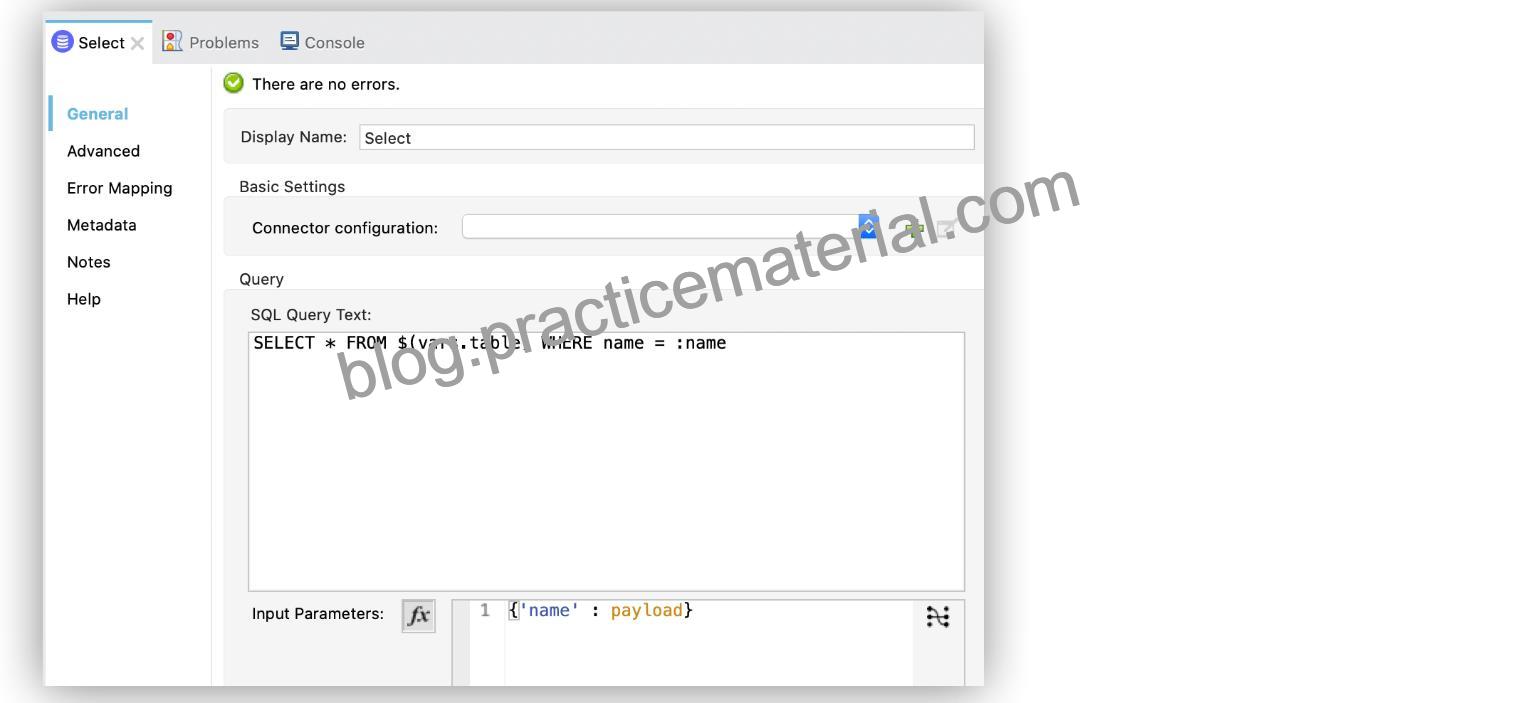
Refer to the exhibit.

How should be the where clause written for the configured input parameters in such a way that it achieves below SQL query?


NEW QUESTION 64
Refer to the exhibits.


The Batch job processes an array of strings.
What information is logged by the logger component after the batch job scope completes processing of the input payload?


NEW QUESTION 65
A web client submits a request to http://localhost:8081?flrstName=john. What is the correct DataWeave expression to access the firstName parameter?


NEW QUESTION 66
Refer to the exhibits.
A web client submits a request to below flow. What is the output at the end of the flow?


NEW QUESTION 67
What is the trait name you would use for specifying client credentials in RAML?


NEW QUESTION 68
Refer to the exhibits.

The Mule application does NOT define any global error handlers.
The Validation component in the private flow throws an error
What response message is returned to a web client request to the main flow’s HTTP Listener?


NEW QUESTION 69
Refer to the exhibit.

The Mule application’s connectors are configured with property placeholders whose values are set in the config.yaml file What must be added to the Mule application to link the config.yaml file’s values with the property placeholders?


NEW QUESTION 70
According to MuleSoft. what is the first step to create a Modern API?


NEW QUESTION 71
Refer to the exhibit.

A Mule event is composed of a hierarchy of objects. Where in the hierarchy are variables stored?


NEW QUESTION 72
Refer to the exhibits.


A web client sends a POST request with the payload {“oid”: “1000”, “itemid”: “AC200”, “qty”: “4” } to the Mule application. The File Write operation throws a FILE:CONNECTIVITY error.
What response message is returned to the web client?


NEW QUESTION 73
A Utlility.dwl is located in a Mule project at src/main/resources/modules. The Utility.dwl file defines a function named encryptString that encrypts a String What is the correct DataWeave to call the encryptString function in a Transform Message component?


NEW QUESTION 74
Which Mule component provides a real-time, graphical representation of the APIs and mule applications that are running and discoverable?


NEW QUESTION 75
Refer to the exhibit.

What is the response to a web client request to http://localhost:8081?


NEW QUESTION 76
Refer to the exhibit.

What is the correct way to create a user?


NEW QUESTION 77
Refer to the exhibits.


The main flow contains a Flow Reference component configured to call the child flow What part(s) of a Mule event passed to the Flow Reference component are available in the child flow?


NEW QUESTION 78
Refer to the exhibit.

What is a valid expression for the Choice router’s when expression to route events to the documenticShipping flow?


NEW QUESTION 79
What is not the function of API Gateway ?


NEW QUESTION 80
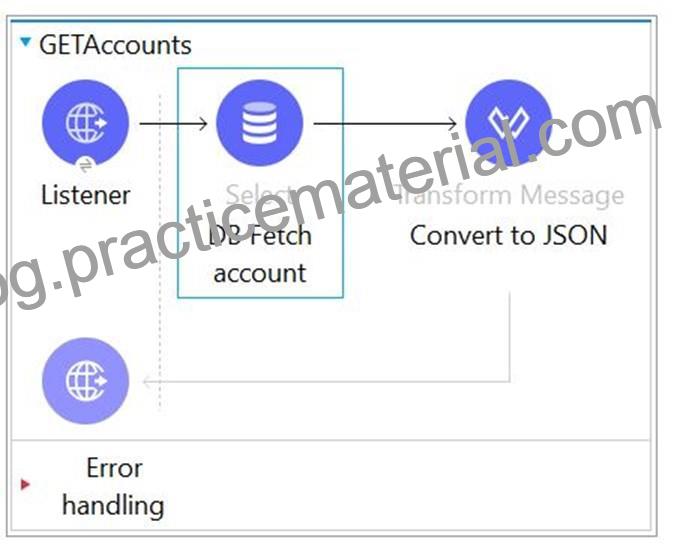
Refer to the exhibit.

What data is expected by the POST /accounts endpoint?


NEW QUESTION 81
Refer to the exhibits. In the choice router, the When expression for the domestic shipping route is set to “#[payload= “FR”]”.
What is the output of logger after the execution of choice router is completed?


Salesforce Salesforce-MuleSoft-Developer-I Exam Syllabus Topics:

Topic Details
Topic 1
  • Transforming Data with DataWeave: It involves writing DataWeave scripts and using DataWeave functions. This topic also includes defining and using DataWeave variables, functions, and modules, and applying correct syntax.
Topic 2
  • Processing Records: Processing records includes methods for processing individual records in a collection and explaining how Mule events are processed by the For Each scope. It also involves using the Batch Job with Batch Steps and a Batch Aggregator.
Topic 3
  • Structuring Mule Applications: Structuring Mule applications covers parameterizing an application and defining and reusing global configurations. It includes breaking an application into multiple flows using private flows, subflows, and the Flow Reference component.
Topic 4
  • Debugging and Troubleshooting Mule Applications: Using breakpoints to inspect a Mule event during runtime, installing missing Maven dependencies, and reading and deciphering Mule log error messages are sub-topics of this topic.
Topic 5
  • Building API Implementation Interfaces: This topic involves manually creating a RESTful interface for a Mule application and generating a REST Connector from a RAML specification. It also includes describing the features and benefits of APIkit.
Topic 6
  • Deploying and Managing APIs and Integrations: It includes packaging Mule applications for deployment and deploying them to CloudHub. This topic also involves using CloudHub properties, creating and deploying API proxies, connecting an API implementation to API Manager, and applying policies to secure an API.


Easy Success Salesforce Salesforce-MuleSoft-Developer-I Exam in First Try: https://www.practicematerial.com/Salesforce-MuleSoft-Developer-I-exam-materials.html

Related Links: myportal.utt.edu.tt myportal.utt.edu.tt myportal.utt.edu.tt myportal.utt.edu.tt www.slideshare.net jacobscott67888.blogspot.com

Leave a Reply

Your email address will not be published. Required fields are marked *

Enter the text from the image below